About Professor George Lykotrafitis
George Lykotrafitis is a Professor of Mechanical Engineering at the University of Connecticut. He joined UConn in 2009 and became a full professor in 2023. He earned a B.S. in Physics from the National University of Athens (1986), a Ph.D. in Applied Mathematics and Physical Sciences from the National Technical University of Athens (2001), and master’s and doctoral degrees in Mechanical Engineering from the California Institute of Technology (2003 and 2006). From 2006 to 2008, he was a postdoctoral fellow in Materials Science and Engineering at the Massachusetts Institute of Technology.
His research combines mathematical modeling and computational simulation with atomic force microscopy, super-resolution imaging, optical interferometry, and microfluidics to investigate cellular biomechanics. His contributions include models of red blood cell and axon membranes and experimental studies of adhesion receptors and neuronal ion channels. His honors include the American Heart Association Scientist Development Grant (2012), the NSF CAREER Award (2014), the Excellence in Research & Creativity: Early Career Award from the AAUP UCONN Chapter (2014), UConn Mechanical Engineering’s Research Excellence Award (2015), and an IBM Fellowship at Brown University (2018).
Laboratory Activities
The Applied Dynamic Mechanics Laboratory at the University of Connecticut investigates how molecular structure, mechanical forces, and interactions among individual components shape biological and autonomous systems. Our research combines experiments, mathematical modeling, computational simulation, and machine learning.
- Cellular mechanics. We study how membrane and cytoskeletal organization govern the deformation, adhesion, protein diffusion, and stability of red blood cells and neurons. Atomic force microscopy, force spectroscopy, advanced fluorescence microscopy, and coarse-grained molecular dynamics connect molecular mechanisms to cellular behavior in health, disease, and injury, including sickle cell disease and axonal damage.
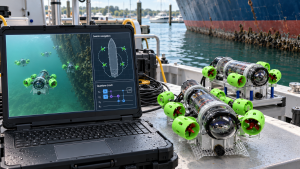
- Mini-AUV autonomy. Our robotics research develops compact autonomous underwater vehicles (mini-AUVs), integrating computer vision, deep reinforcement learning, and docking systems. Simulations and underwater experiments support navigation, obstacle avoidance, and multi-agent coordination for inspection of submerged hulls, ports, and bridge foundations.
- Applied quantum computing. We explore hybrid quantum–classical methods for swarm navigation and investigate how local decisions produce collective behavior. We also investigate quantum reservoir computing for temporal information processing, swarm dynamics, and electroencephalogram (EEG) classification in epilepsy and mild traumatic brain injury.
Across these areas, our goal is to establish predictive models, explain complex behavior, and develop experimentally grounded methods that advance cellular biophysics, intelligent autonomy, and efficient computation.